

By Dr. Ernest Sorenson, DPM — Sorenson Foot and Ankle, Magnolia, TX
Quick summary: Red light therapy (also called photobiomodulation, or PBM) uses red and near-infrared light to target mitochondria inside cells. Devices in this category, including RedVive panels used at Sorenson Foot and Ankle, are generally FDA-cleared for temporary relief of minor muscle and joint pain, muscle spasm, stiffness, and local circulation. In Dr. Sorenson’s own clinical experience, it’s become a go-to modality alongside Class IV laser for sprains, strains, and post-operative recovery — and he’s used it himself with noticeable results. It’s available both in-office and as a take-home device. This article is educational only; see the full disclaimer below.
This article is for general education only. It is not medical advice, does not diagnose or treat any condition, and reading it does not create a doctor-patient relationship with Dr. Ernest Sorenson or Sorenson Foot and Ankle. Red light therapy affects each person differently, and it is not a substitute for an in-person evaluation. If you have a foot or ankle concern, please schedule a visit so we can assess your specific situation.
When I opened Sorenson Foot and Ankle in Magnolia, TX, I wanted to build a practice that offers patients the full range of tools available for recovery — not just surgery, medications, and injections, but the regenerative and recovery-focused therapies that are becoming more available in musculoskeletal care. As part of that, we’ve added RedVive red light therapy panels to our office as one adjunct among several in our treatment protocols. Below is a general, educational overview of what this therapy is, what the current evidence does and does not show, and how we’re using it.
What Is Photobiomodulation (PBM) and How Does Red Light Therapy Work?
Red light therapy, also called photobiomodulation or low-level light therapy, uses specific wavelengths of red and near-infrared light to interact with cells in a very targeted way. Unlike heat lamps or tanning devices, PBM isn’t about warming tissue — it’s about delivering light energy at wavelengths your cells are able to absorb and use.
The RedVive panels we use emit multiple wavelengths across the red spectrum (commonly cited in the 630–660nm range) and the near-infrared spectrum (commonly cited in the 810–850nm range). In general, red light is thought to act more on skin and superficial tissue, while near-infrared light is thought to penetrate more deeply toward muscle, tendon, and joint structures. This is a general description of how these wavelengths behave in tissue, not a claim about what any specific session will accomplish for any specific patient.
How Does Red Light Therapy Affect Cells? The Mitochondrial Mechanism and What the Evidence Shows
A commonly proposed mechanism for PBM involves mitochondria, the energy-producing structures inside cells that generate ATP, the molecule cells use to fuel repair and normal function. The leading hypothesis in the research literature is that red and near-infrared light is absorbed by a mitochondrial enzyme called cytochrome c oxidase, which may help support ATP production, local circulation, and a reduction in oxidative stress in the treated area.
It’s important to be clear about what this means and doesn’t mean. This describes a proposed biological mechanism supported by laboratory and some clinical research — it is not a guarantee of any particular clinical outcome, and results are known to vary by device, dose, wavelength, treatment duration, and the individual patient. Photobiomodulation research is still evolving, and reputable sources are consistent in noting that individual response varies.
Red Light Therapy for Foot and Ankle Conditions: Sprains, Tendinitis, Plantar Fasciitis, and Neuropathy
Many red and near-infrared light devices in this general category hold FDA 510(k) clearance for indications such as temporary relief of minor muscle and joint pain, muscle spasm, minor stiffness, and temporary local increase in blood circulation. Clearance is specific to the exact device and its cleared indications for use — it is not a blanket approval for every condition a light-based device might be used for. We’re happy to answer questions about the specific clearance documentation for the equipment we use.
In my own practice, PBM has become one of the modalities I reach for most, right alongside my Class IV laser and shockwave therapy. I’ve seen it make a real difference for patients working through sprains, strains, and the swelling and pain that come with post-operative recovery — it’s a comfortable, easy addition to a recovery plan, and I genuinely like having it available. I’ve also used it on myself after a sprain, and I noticed a real difference in my own discomfort during recovery. That’s my clinical experience and personal use, not a clinical trial — I want to be upfront about that distinction, because individual results still vary from person to person.
Here’s where I incorporate PBM most often:
- Ankle and foot sprains — as part of recovery, alongside protective and rehabilitative care
- Contusions and soft tissue bruising
- Tendinitis (Achilles, posterior tibial, peroneal, and others) — often paired with Class IV laser or shockwave therapy
- Plantar fasciitis — a lower-intensity, at-home-compatible option alongside orthotics and stretching
- Post-operative recovery — for swelling and discomfort following procedures, as part of a broader recovery protocol
- Neuropathy (nerve pain)-related discomfort — an area I follow closely as more research develops
Red light therapy isn’t a cure and results aren’t guaranteed for any individual — it’s a well-tolerated tool I use alongside the rest of a patient’s care, not in place of it.
In-Office vs. At-Home Red Light Therapy: How Often Should You Use It?
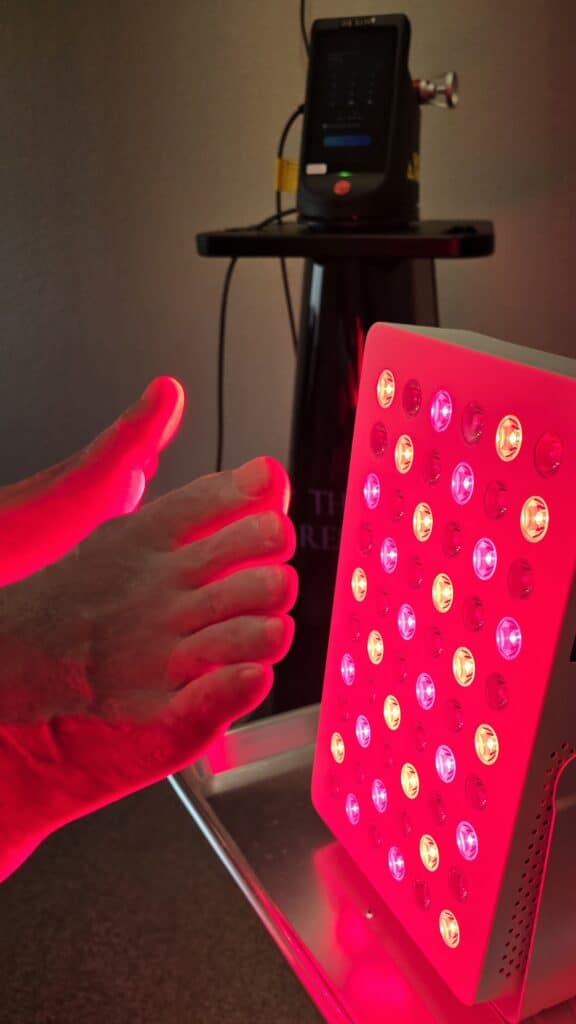
Some published protocols in the PBM literature emphasize regular, low-time-commitment sessions over a single high-intensity treatment, though optimal dosing (wavelength, power, duration, and frequency) is still an active area of research and is not standardized across conditions or devices. With that in mind, we offer red light in two settings:
- In-office sessions, built into visit protocols alongside other treatments we provide.
- Take-home RedVive panels, available for purchase for patients who want the option of using a device on their own schedule at home. As an Authorized RedVive Practitioner, our practice participates in RedVive’s Practitioner Purchase Link program: if you purchase a device through Redvive.org/DrSorenson, our practice receives a marketing fee from RedVive. This does not change the price you pay, purchasing is entirely optional, and it is not required for and does not affect any clinical care we provide. Product claims made on RedVive’s website are their own and are not evaluated, verified, or endorsed by Sorenson Foot and Ankle. As with any wellness product, we encourage patients to make this decision based on their own goals and budget, not on any promise of a specific result. I recommend patients discuss the option in office and experience a courtesy demo during their evaluation for their foot and ankle condition prior to purchase.
Is This Right for You?
Red light therapy is generally well tolerated, but it isn’t right for everyone. Talk with a qualified provider before starting if you have a photosensitivity condition or disorder, are pregnant, have a history of skin cancer, or are taking medications that increase light sensitivity. This article does not account for your individual health history, and it should not be used to decide for yourself whether PBM is appropriate — that determination should be made in an actual visit with a licensed provider.
If you’re an existing patient, you’re welcome to ask about this at your next visit. If you’re not yet a patient and are considering care, we’d encourage you to schedule a visit so we can evaluate your specific situation rather than relying on general information like this article.
Frequently Asked Questions About Red Light Therapy for Feet and Ankles
Is red light therapy FDA-approved? Devices in this category are typically FDA-cleared, not FDA-approved — the two terms mean different things. Clearance (via the 510(k) pathway) is granted for specific indications, commonly the temporary relief of minor muscle and joint pain, muscle spasm, stiffness, and local increase in blood circulation. Clearance for one indication doesn’t mean a device is cleared or proven effective for every condition.
Does red light therapy help plantar fasciitis or neuropathy? In Dr. Sorenson’s clinical experience, PBM is a helpful part of a broader treatment plan for heel pain and neuropathy-related discomfort, often alongside orthotics, stretching, or other established treatments. Published research in this area is still developing, so we’re upfront that this reflects clinical experience and ongoing science together, not a guaranteed or standardized outcome for every patient.
How often do you use red light therapy in the office? We incorporate it into visit protocols where clinically appropriate, sometimes alongside other modalities such as Class IV laser or shockwave therapy. There’s no single standardized frequency across all conditions, so timing is discussed as part of an individual treatment plan.
Can I buy a RedVive device to use at home? Yes. Take-home RedVive panels are available for purchase independent of any in-office treatment plan. Purchasing is optional and does not affect the clinical care we provide.
Is red light therapy safe? It’s generally well tolerated, but it isn’t appropriate for everyone. Talk with a qualified provider first if you have a photosensitivity condition, are pregnant, have a history of skin cancer, or take medications that increase light sensitivity.
Disclaimer: This article is for general educational and informational purposes only. It is not medical advice, is not intended to diagnose, treat, cure, or prevent any disease or condition, and does not create a physician-patient (or podiatrist-patient) relationship between the reader and Dr. Ernest Sorenson or Sorenson Foot and Ankle. Statements about photobiomodulation reflect a general summary of publicly available research and are not representations that any specific outcome will occur for any specific individual. Individual results vary. Any device referenced may have specific FDA clearance limited to particular indications for use; clearance for one indication does not imply clearance or effectiveness for other conditions. Always consult a qualified healthcare provider regarding any medical condition or before beginning any new therapy.