

Chronic Nerve Pain Doesn’t Always Respond to Conventional Treatment.
Discover Scrambler Therapy®—an advanced, noninvasive treatment option for chronic neuropathic pain, now available locally at Sorenson Foot and Ankle in Magnolia, Texas.
Scrambler Therapy uses targeted cutaneous electrostimulation to deliver synthesized non-pain information through nerve pathways associated with chronic pain. Rather than simply masking or temporarily distracting from pain, the treatment is designed to change the pain information being transmitted through the nervous system.
At Sorenson Foot and Ankle, Dr. Ernest Sorenson uses this technology specifically for appropriate patients with chronic neuropathic pain involving the feet and lower extremities.
Advanced Neuropathic Pain Treatment—Available in Magnolia, Texas
Patients dealing with chronic nerve pain of the feet and lower extremities can access Scrambler Therapy® at Sorenson Foot and Ankle in Magnolia, Texas.
The practice serves patients throughout Magnolia, The Woodlands, Conroe, Tomball, Montgomery, Waller, Hockley, Cypress, Spring, Houston, and surrounding communities.
Scrambler Therapy provides another treatment option for appropriately selected patients whose chronic neuropathic pain has persisted despite conventional treatment.
A Drug-Free Approach to Chronic Neuropathic Pain
Many patients with chronic nerve pain have already tried medications such as gabapentin, pregabalin, duloxetine, topical medications, injections, physical therapy, or other treatments. Scrambler Therapy offers a fundamentally different approach.
It is a non-drug, noninvasive form of electroanalgesia that uses specialized electrical information delivered through electrodes placed on the skin. Scrambler Therapy does not administer medication as part of the treatment.
For appropriately selected patients, it may provide the possibility of meaningful pain relief without requiring another medication to create the therapeutic effect.
- No injections
- No incisions
- No anesthesia
- No implanted device
- No medication administered during treatment
- Generally no procedural downtime
Some patients who respond may ultimately be able to reduce reliance on certain pain medications under appropriate medical supervision. Medication reduction or discontinuation is not guaranteed and should never occur without guidance from the appropriate prescribing clinician.
Helping the Nervous System Process Different Information
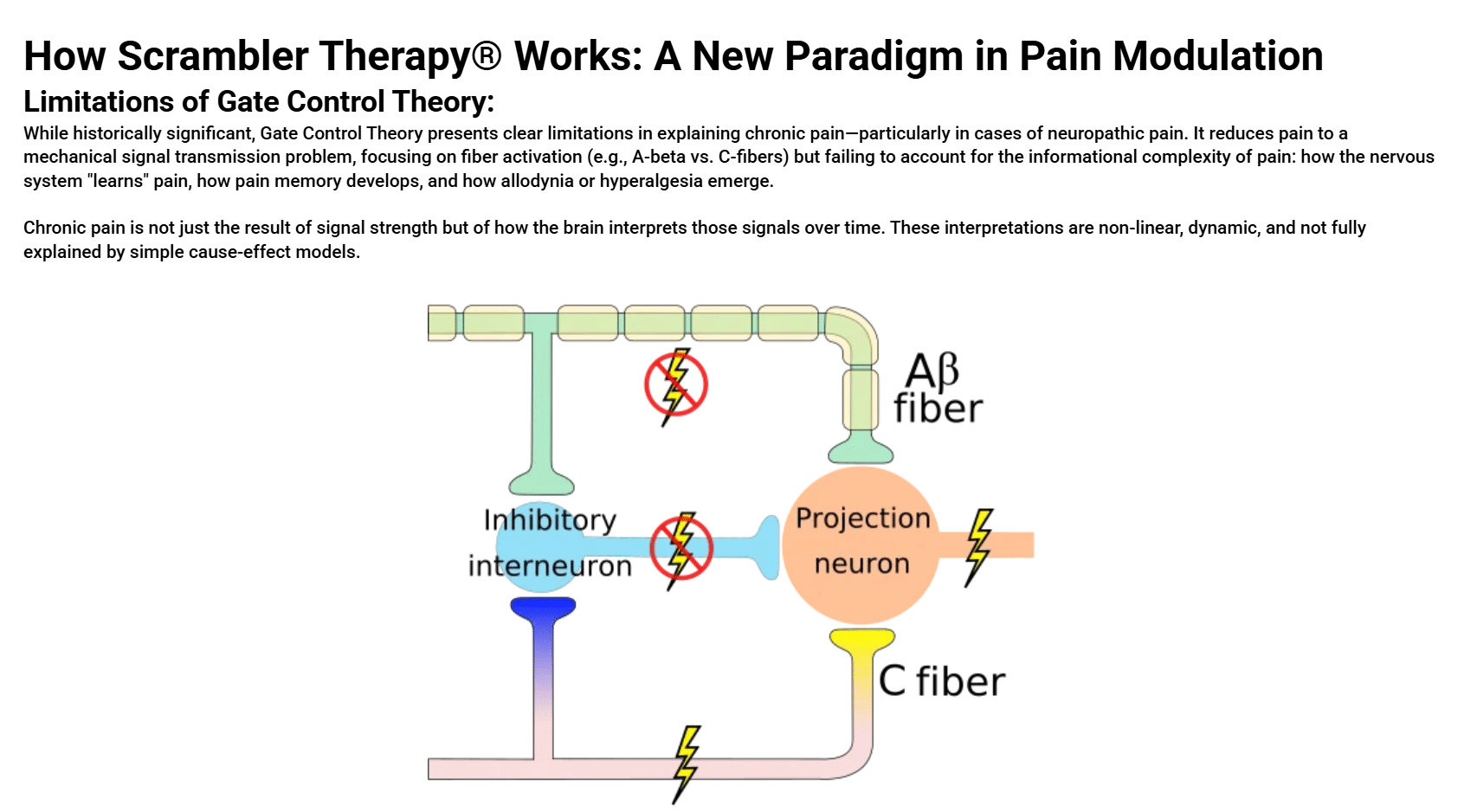
One way to think about Scrambler Therapy is as a form of neuromodulation or “nerve retraining.” Chronic neuropathic pain can involve persistent abnormal pain information traveling through the nervous system.
Scrambler Therapy is designed to introduce synthesized non-pain information through those nerve pathways. Over a series of treatments, the goal is to help the nervous system process non-pain information rather than continuing to interpret abnormal nerve signals as persistent pain.
Scrambler Therapy does not physically regenerate or repair damaged nerves. Its treatment objective is the abnormal pain information associated with neuropathic pain.
Technical Content Direction
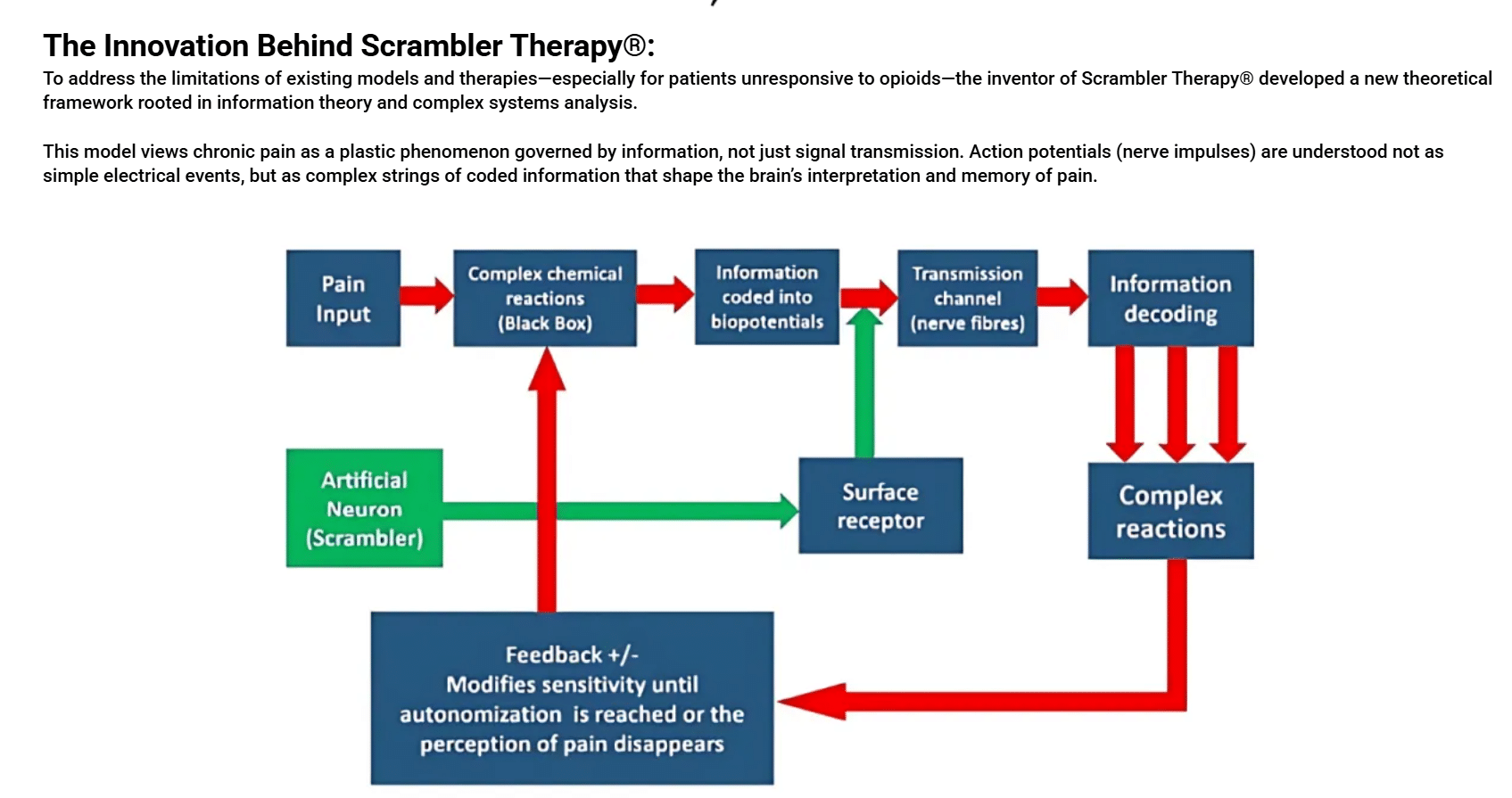
The supplied mechanism graphics discuss gate-control theory, information theory, artificial-neuron concepts, dynamic signal complexity, C-fiber/surface-receptor concepts, and synthetic “non-pain” information. Use these materials as reference for a simplified patient-facing explanation. A deeper “Learn More About How It Works” accordion/expandable section may be used for technical readers.
Could Scrambler Therapy Be Right for Your Nerve Pain?
Patient-described neuropathic symptoms may include:
- Burning
- Shooting
- Electrical
- Stabbing
- Tingling
- Hypersensitivity to touch
- Persistent painful nerve sensations
Scrambler Therapy may be considered for appropriately selected patients with chronic neuropathic pain involving the feet and lower extremities, including certain patients with peripheral neuropathic pain and chemotherapy-induced peripheral neuropathy. An evaluation is necessary to determine whether the patient’s symptoms and underlying condition make treatment appropriate.
Clinical Evidence & Published Research
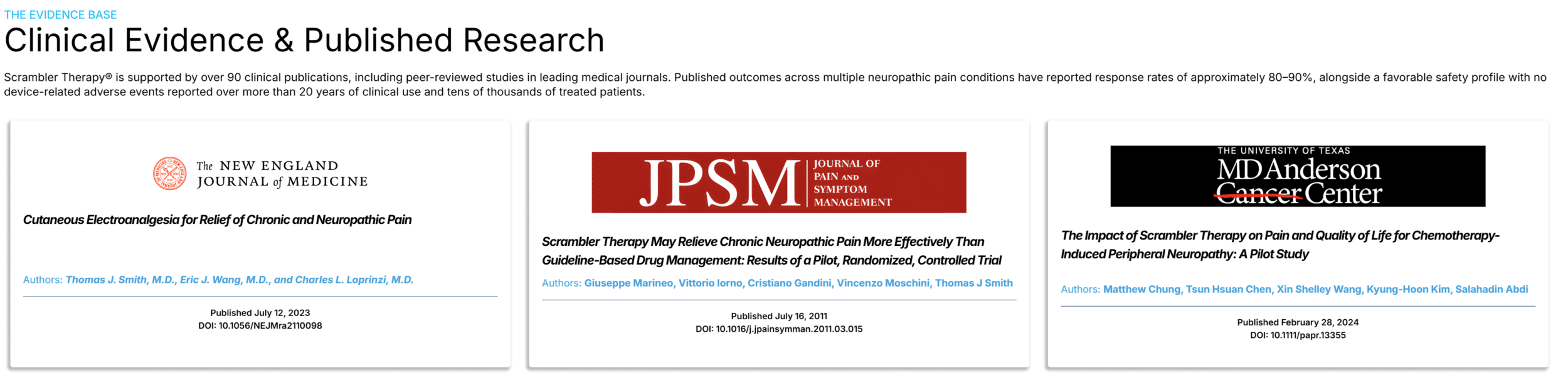
This should be a substantial educational section, not merely a logo strip. The supplied Scrambler Therapy reference materials include examples of published research and academic/clinical use. Use study cards or a clean research layout where practical.
Reference materials supplied include examples associated with:
- The New England Journal of Medicine
- Journal of Pain and Symptom Management
- MD Anderson Cancer Center
The supplied institutional graphic also identifies Johns Hopkins, Cleveland Clinic, MD Anderson, UCLA, Mayo Clinic, and Indiana University Health as sites where Scrambler Therapy has been used in clinical or research settings.
References to outside institutions are for patient education regarding Scrambler Therapy research and clinical use and do not imply endorsement of or affiliation with Sorenson Foot and Ankle.
The supplied TENS comparison table is useful reference material. Prefer a clean, branded Sorenson Foot and Ankle comparison component rather than inserting a screenshot of the source table.
Specialized Technology. Lower-Extremity Expertise. Available in Magnolia.
Chronic nerve pain involving the feet and lower extremities often requires more than simply identifying that a patient “has neuropathy.”
Dr. Ernest Sorenson evaluates the distribution of pain, sensation, neurologic findings, circulation, musculoskeletal function, medical history, medications, prior procedures, previous treatments, and other relevant factors before determining whether Scrambler Therapy may be appropriate.
Scrambler Therapy is operator-dependent. Electrode placement, pain mapping, patient feedback, stimulation adjustment, and reassessment throughout the treatment series are important components of treatment.
Uses advanced technology and focused lower-extremity expertise to help patients preserve mobility, independence, sleep, activity, and quality of life whenever possible.
Chronic Nerve Pain May Not Have to Define Your Next Step.
If burning, shooting, electrical, stabbing, hypersensitive, or persistent nerve pain in your feet or lower extremities is interfering with your sleep, walking, work, exercise, or quality of life, Scrambler Therapy® may provide another treatment option.
Schedule an evaluation with Dr. Ernest Sorenson at Sorenson Foot and Ankle to determine whether Scrambler Therapy may be appropriate for you.
Se Habla Español
Step Into Elevated Care℠