

If you suffer from diabetic neuropathy, chemotherapy-induced peripheral neuropathy (CIPN), Complex Regional Pain Syndrome (CRPS), hereditary neuropathy, idiopathic neuropathy, or another form of chronic nerve pain, you’ve probably been told that medications such as gabapentin, pregabalin (Lyrica), or duloxetine (Cymbalta) are your primary treatment options.
While these medications can certainly help some patients, many people continue to experience burning, tingling, pins and needles, electric shocks, hypersensitivity, or constant nerve pain despite years of treatment. Others have undergone injections, spinal cord stimulator trials, implanted stimulators, pain pumps, or other pain management procedures and still find themselves living with chronic pain.
At Sorenson Foot & Ankle, I wanted to offer another option for Lower Extremity focused treatment of neuropathic pain.
Scrambler Therapy® is one of the regenerative and restorative technologies we’ve incorporated into our practice because my goal has never been simply to mask symptoms. I want to identify the underlying cause of pain whenever possible and provide treatments that improve function, decrease pain, and ultimately improve quality of life.
What Is Scrambler Therapy®?
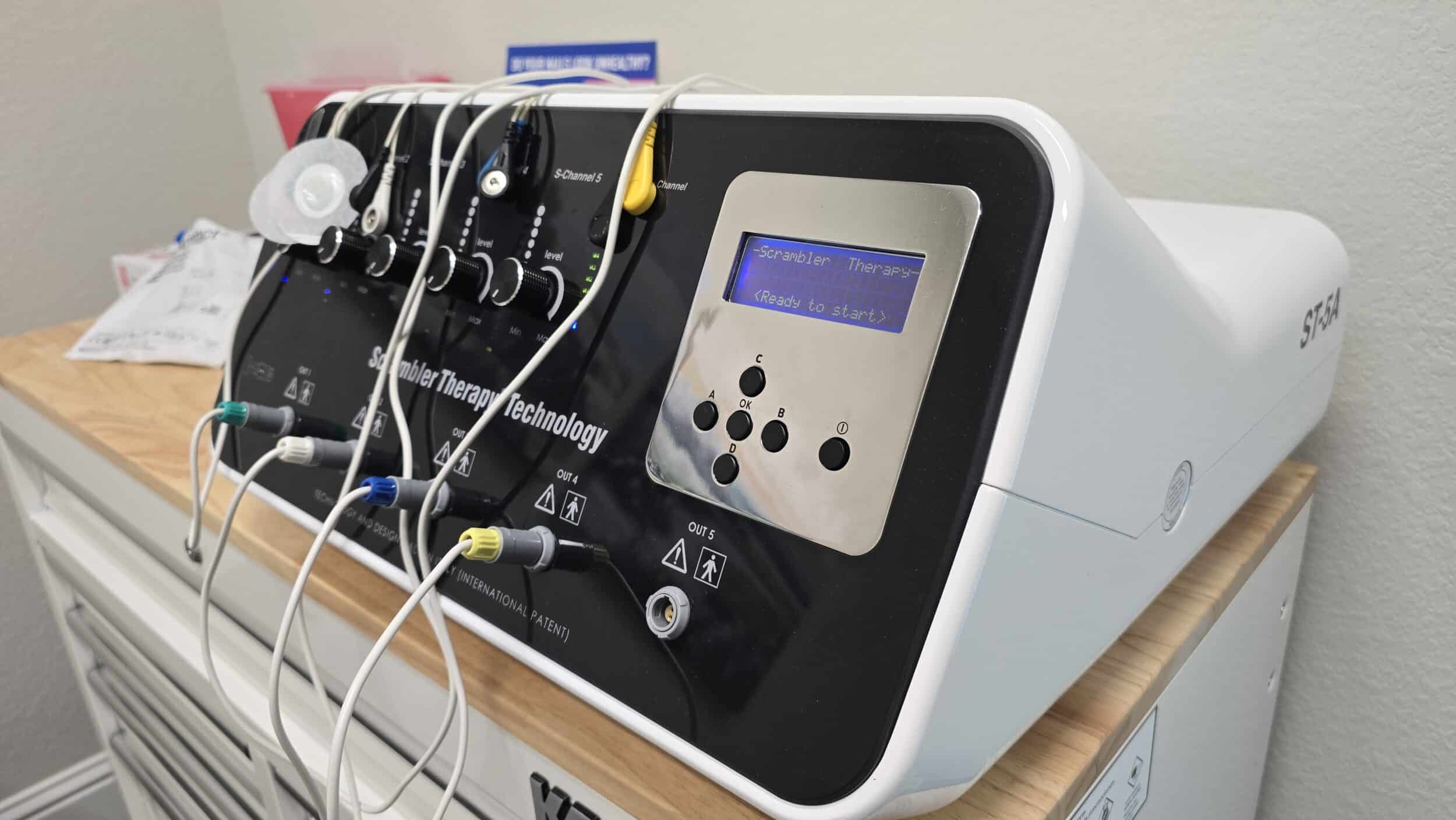
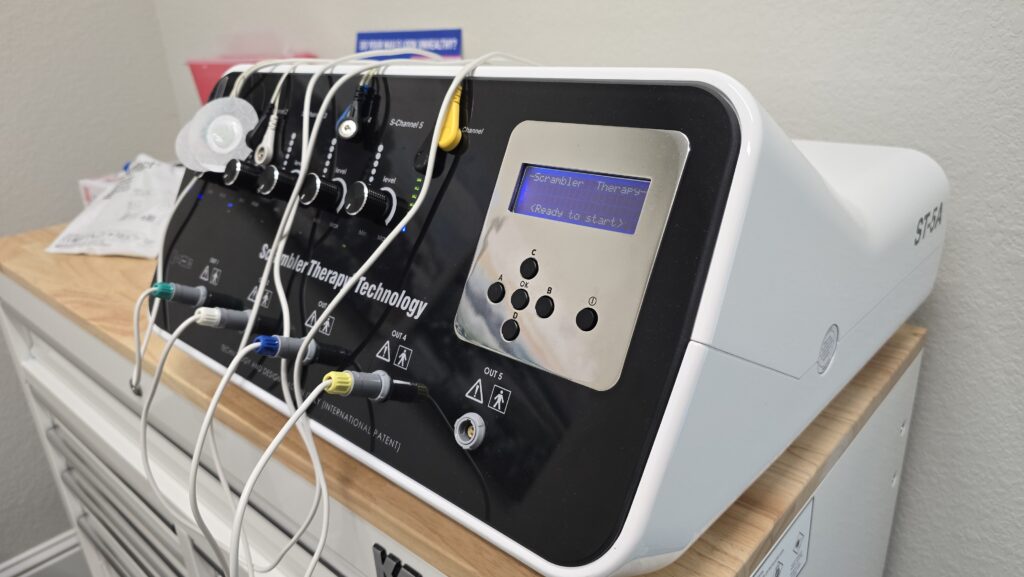
Scrambler Therapy® is a form of non-invasive neuromodulation designed to treat chronic neuropathic pain.
Rather than blocking pain with medication, Scrambler Therapy® works by replacing abnormal pain information being sent to the brain with “non-pain” information.
One of the easiest ways to understand it is as a neurological “bait-and-switch.”
When nerves become damaged—whether from diabetes, chemotherapy, hereditary conditions, or sometimes for reasons we never completely identify—they may continue sending abnormal pain signals long after they should have stopped. Over time, the brain becomes accustomed to interpreting those signals as burning, tingling, stabbing, electrical sensations, or constant pain.
Scrambler Therapy® attempts to interrupt this process by delivering carefully controlled “non-pain” information through electrodes placed on healthy skin surrounding the painful area. Instead of continually receiving pain messages, the brain begins receiving normal sensory information.
The goal is not to numb the area.
The goal is to help retrain how the brain interprets those incoming signals.
Your Brain Is Constantly Changing
One of the most fascinating characteristics of the nervous system is something called neuroplasticity.
Neuroplasticity simply means your brain is capable of changing throughout your entire life.
Every day you create new neural pathways.
You learn someone’s name.
You meet a new friend.
You learn a new hobby.
You improve your golf swing.
You practice an instrument.
You remember a new route to work.
Your brain is constantly making new connections while strengthening others.
This remarkable adaptability is one of the reasons human beings continue learning throughout life.
Scrambler Therapy® attempts to utilize this same ability by encouraging the brain to build new, healthier interpretations of sensory information rather than continuing to recognize those signals as pain.
Researchers continue to study the precise mechanisms behind neuromodulation, but neuroplasticity is one of the foundational concepts behind therapies designed to retrain the nervous system.
What Conditions May Benefit?
Scrambler Therapy® may be considered for appropriately selected patients with chronic neuropathic pain, including:
- Painful diabetic peripheral neuropathy
- Chemotherapy-induced peripheral neuropathy (CIPN)
- Idiopathic peripheral neuropathy
- Hereditary neuropathies
- Chronic post-surgical neuropathic pain
- Complex Regional Pain Syndrome (CRPS)
- Other chronic neuropathic pain syndromes after appropriate evaluation
Every patient is individually evaluated to determine whether Scrambler Therapy® is an appropriate treatment option.
What Happens During Treatment?
During each 45 minute Scrambler Therapy® session, electrodes are strategically placed on healthy skin surrounding the painful area according to established treatment protocols.
The stimulation is then gradually adjusted according to each patient’s comfort.
One of the biggest misconceptions is that stronger stimulation equals better results.
It doesn’t.
Treatment should never be painful.
There is absolutely no therapeutic benefit to making a patient uncomfortable while during it’s use.
Instead, the stimulation is carefully titrated throughout the treatment until the patient experiences a comfortable sensation while achieving the greatest possible reduction in pain.
Our goal during every treatment session is simple:
Reduce the patient’s burning, tingling, pins and needles, or neuropathic pain to zero—or as close to zero as possible—while they are sitting in the treatment chair.
When that happens, we’re giving the brain the greatest opportunity to begin learning a healthier, non-painful interpretation of those nerve signals.
Treatment Is Progressive
Scrambler Therapy® is not intended to be a “one treatment fixes everything” procedure.
Instead, we evaluate progress after every session by looking for two important improvements:
- A longer period before the pain returns.
- A lower overall baseline pain level.
As treatment progresses, patients frequently notice that relief lasts progressively longer.
Treatments are serial in nature meaning we usually start on a Monday and continue through Friday, in some circumstance on Saturday and Sunday if long distance travel was involved to be treated, this can mean 2 weeks of treatments daily.
At our office, we generally continue treatment daily until the patient has gone 48 consecutive hours without pain returning.
At that point, we consider the patient to have entered remission, although every patient is different and occasional maintenance treatment may become appropriate in select cases.
The average treatment course is approximately 10 treatments, although this varies considerably from patient to patient.
Some individuals respond after only a few sessions.
Others require additional treatments before meaningful improvement occurs.
Neuropathy and CRPS Are Different
Painful diabetic neuropathy and many peripheral neuropathies tend to be more “straightforward” to treat.
Published clinical studies evaluating Scrambler Therapy® have demonstrated encouraging success rates in patients with painful diabetic peripheral neuropathy and several other neuropathic pain conditions, although individual results naturally vary.
Complex Regional Pain Syndrome (CRPS), however, is a much more complicated condition.
CRPS remains one of the least understood chronic pain disorders in medicine.
Some CRPS patients experience significant improvement after only a few treatments.
Others may require seven, eight, nine, ten, or even more treatments before meaningful improvement begins.
That doesn’t necessarily mean Scrambler Therapy® isn’t working.
Rather, it reflects the complexity and unpredictability of CRPS itself.
Every patient’s nervous system behaves differently.
Scrambler Therapy® at Leading Medical Centers
Scrambler Therapy® has been incorporated into clinical care and research at several respected academic medical centers throughout the United States. Institutions including The University of Texas MD Anderson Cancer Center, Johns Hopkins Medicine, Cleveland Clinic, Mayo Clinic, and UCLA have utilized Scrambler Therapy® for selected patients with chronic neuropathic pain, particularly chemotherapy-induced peripheral neuropathy (CIPN) and other difficult-to-treat pain conditions. At MD Anderson Cancer Center, Scrambler Therapy® has been part of the institution’s multidisciplinary pain management program for more than 15 years, where it has primarily been offered to active cancer patients experiencing neuropathic pain related to cancer treatment. As the body of clinical evidence continues to grow, additional healthcare institutions continue to evaluate and expand the role of Scrambler Therapy® in the management of chronic neuropathic pain.
My Experience
I’ll admit something.
When I first learned about Scrambler Therapy®, I was skeptical.
As physicians, we should be.
Medicine should always remain evidence-based, and healthy skepticism protects our patients.
During the very first week our office opened in June 2025, I had the privilege of receiving one-on-one clinical training from a Scrambler Therapy® instructor who traveled from New York to our office for 3 days of training with 6 patients.
Since then, Scrambler Therapy® has been part of our practice for over a year.
We’ve treated numerous patients suffering from painful diabetic neuropathy, chemotherapy-induced peripheral neuropathy, and Complex Regional Pain Syndrome with encouraging results.
Watching someone arrive with burning pain in their feet and then seeing that pain disappear—or nearly disappear—or begin to walk without a cane or limp or use of knee scooter during and after treatment is incredibly rewarding.
Not every patient responds.
No treatment in medicine works for everyone.
But when someone is a responder, the improvement in quality of life can be remarkable.
One of the most satisfying aspects of offering Scrambler Therapy® is watching patients begin doing things they had stopped doing because of pain—walking farther, sleeping better, exercising again, or simply enjoying life with less discomfort.
Is Scrambler Therapy® Right for Everyone?
No.
One of the most important parts of my job is determining why someone is experiencing nerve pain before recommending treatment.
If a patient’s symptoms are actually caused by an active nerve entrapment or mechanical nerve compression, Scrambler Therapy® is generally not expected to correct the underlying problem.
Examples include:
- Lumbar nerve root impingement (“pinched nerves” in the lower back)
- Tarsal tunnel syndrome
- Common peroneal nerve entrapment
- Tibial nerve entrapment
- Other peripheral nerve compression syndromes
If the nerve continues to be physically compressed, the source of the abnormal signaling remains present. In these situations, the underlying mechanical cause should be appropriately diagnosed and treated before attempting Scrambler Therapy®.
For that reason, every patient undergoes a thorough history, physical examination, and review of any appropriate imaging or electrodiagnostic studies before beginning treatment. Additional diagnostic testing may be recommended when necessary to better identify the true source of symptoms.
Patients with implanted electrical medical devices also require special consideration.
Individuals with pacemakers, implantable cardioverter-defibrillators (ICDs), spinal cord stimulators, intrathecal pain pumps, or other implanted electrical medical devices require careful evaluation before Scrambler Therapy® is considered.
Depending on the device, its location, manufacturer recommendations, and the proposed treatment area, Scrambler Therapy® may be contraindicated or may require written medical clearance from the physician managing the implanted device.
In selected circumstances—particularly when an implanted device can safely be turned off during treatment and is located well away from the treatment area—Scrambler Therapy® may still be considered after a detailed discussion of the potential risks and benefits.
Patients who elect to proceed despite these considerations may do so only after appropriate medical clearance, signing an informed consent acknowledging the potential risks, and understanding that they are assuming those risks.
Patient safety always comes first.
A Potential Alternative to Lifelong Medication
Many patients pursuing Scrambler Therapy® have already tried:
- Gabapentin
- Pregabalin (Lyrica)
- Duloxetine (Cymbalta)
- Topical medications
- Spinal cord stimulator trials
- Implanted spinal cord stimulators
- Pain pumps
- Numerous pain management procedures
Some continue living with significant pain every single day.
For appropriately selected patients, Scrambler Therapy® offers a completely non-invasive treatment that may significantly reduce neuropathic pain without adding another medication.
Patients who respond well may eventually be able to reduce neuropathic pain medications under the supervision of the physician prescribing them.
Medication changes should never be made without physician guidance.
Is Scrambler Therapy® Covered by Insurance?
Unfortunately, at this time Scrambler Therapy® is generally not covered by insurance, although HSA/HFA may cover.
While that can certainly be frustrating, many patients who have exhausted traditional treatment options feel the opportunity to improve their quality of life is well worth exploring.
As awareness grows and additional research continues to emerge, my hope is that insurance coverage will eventually become more widely available for patients who may benefit from this technology.
Why I Chose to Bring Scrambler Therapy® to Our Practice
Like many physicians, I was introduced to Scrambler Therapy® with a healthy degree of skepticism. New technologies should always be approached thoughtfully and supported by evidence.
What ultimately motivated me wasn’t marketing—it was my patients.
One patient in particular had a profound impact on me: a post op medical professional whose broke an ankle and foot I fixed, diagnosed with Complex Regional Pain Syndrome (CRPS) early on. Watching someone active and dedicated to their care of patients endure a condition that is often poorly understood and incredibly difficult to treat reinforced something I had already begun to realize—we simply need more tools to help people living with chronic neuropathic pain.
That experience led me to study Scrambler Therapy®, review the available clinical evidence, and speak with experienced providers who had been using it successfully. After careful consideration, I made the decision to bring the technology to Sorenson Foot & Ankle.
During the very first week our office opened in June 2025, I received one-on-one clinical training from a Scrambler Therapy® instructor who traveled from New York to our office. Since then, Scrambler Therapy® has become an important part of our practice. We’ve now treated patients with painful diabetic neuropathy, chemotherapy-induced peripheral neuropathy (CIPN), and CRPS, and it has been incredibly rewarding to watch many of those patients regain comfort, function, and quality of life.
I’ll also admit that my skepticism changed after seeing the results firsthand. No treatment in medicine works for everyone, and Scrambler Therapy® is no exception. However, when someone is a responder, the improvement can be remarkable. Watching a patient walk into the office with burning pain and leave with little or no pain during treatment never gets old.
Medicine continues to evolve.
Regenerative medicine.
Photobiomodulation.
Shockwave therapy.
Neuromodulation.
These technologies are not replacements for good medicine. They’re additional tools that, when combined with an accurate diagnosis and thoughtful treatment plan, can help patients who may otherwise feel they’ve run out of options.
Scrambler Therapy® is one of those tools.
It isn’t magic.
It isn’t appropriate for everyone.
It doesn’t replace identifying and treating the underlying cause of pain.
But for the right patient, it can truly be life-changing.
If you’ve been living with diabetic neuropathy, chemotherapy-induced neuropathy, idiopathic neuropathy, hereditary neuropathy, Complex Regional Pain Syndrome (CRPS), or another form of chronic neuropathic pain, we’d be honored to help determine whether Scrambler Therapy® may be an appropriate treatment option for you.
Living with chronic neuropathic pain doesn’t have to be your only option.
Medical Disclaimer
The information provided in this article is intended for educational and informational purposes only and should not be interpreted as medical advice, diagnosis, or treatment. Every patient and every medical condition is unique.
Reading this article or viewing the content on this website does not establish a doctor-patient relationship with Dr. Ernest Sorenson or Sorenson Foot & Ankle.
If you are experiencing foot pain, ankle pain, numbness, burning, tingling, weakness, or other symptoms of neuropathy, you should undergo a comprehensive medical evaluation by a qualified healthcare professional to determine the underlying cause of your symptoms. Appropriate treatment depends on an accurate diagnosis.
Not every patient is a candidate for Scrambler Therapy®, and not every patient will experience the same results. Treatment recommendations are individualized based on each patient’s medical history, physical examination, diagnostic findings, and overall clinical picture. Any testimonials or examples discussed represent individual experiences and should not be interpreted as a guarantee of similar results.
Never start, stop, or change prescription medications without first consulting the healthcare professional who prescribed them.
If you have questions about whether Scrambler Therapy® or another treatment option may be appropriate for you, we encourage you to schedule an evaluation so we can discuss your specific condition and develop a treatment plan tailored to your needs.